The future we expect
What future do we expect?
- 18 trends that will shape 2040
- A futures wheel to trace their knock-on effects
- The expected scenario and the strategy built for it
Stress-test your strategy before the future does.
Most organisations extend the trends they know and build their strategy on that future. In the Anthropocene, the future branches and sometimes breaks: thresholds, cascades, policies that change overnight.
The future we expect: extrapolate, pick the most likely scenario and optimise for it.
The futures we don’t expect: explore several worlds, their risks and thresholds, and look for what holds in all of them.
Each stage produces something the next one puts to the test. By the end, the difference between forecasting, exploring and deciding shows in the result, not just in the definition. The workshop runs over one, two or three days, in English, French or Spanish: the depth changes, the stages don’t.
What future do we expect?
What if the future isn’t the one we expect?
Which actions are robust?
Give shape to an object from your future scenario, with its packaging, label and slogan, so you talk about that future instead of describing it.
The case can be fictional, like La Vaca Utopista, a family-owned dairy group with plants in several countries and markets on three continents, whose strategy you rebuild to 2040. Or it can be tailored to your organisation: your sites, your value chain, your risks and the horizon that makes sense for you. In teams, with a case file, risk cards and a catalogue of actions, each with a cost, a timeline and an owner.
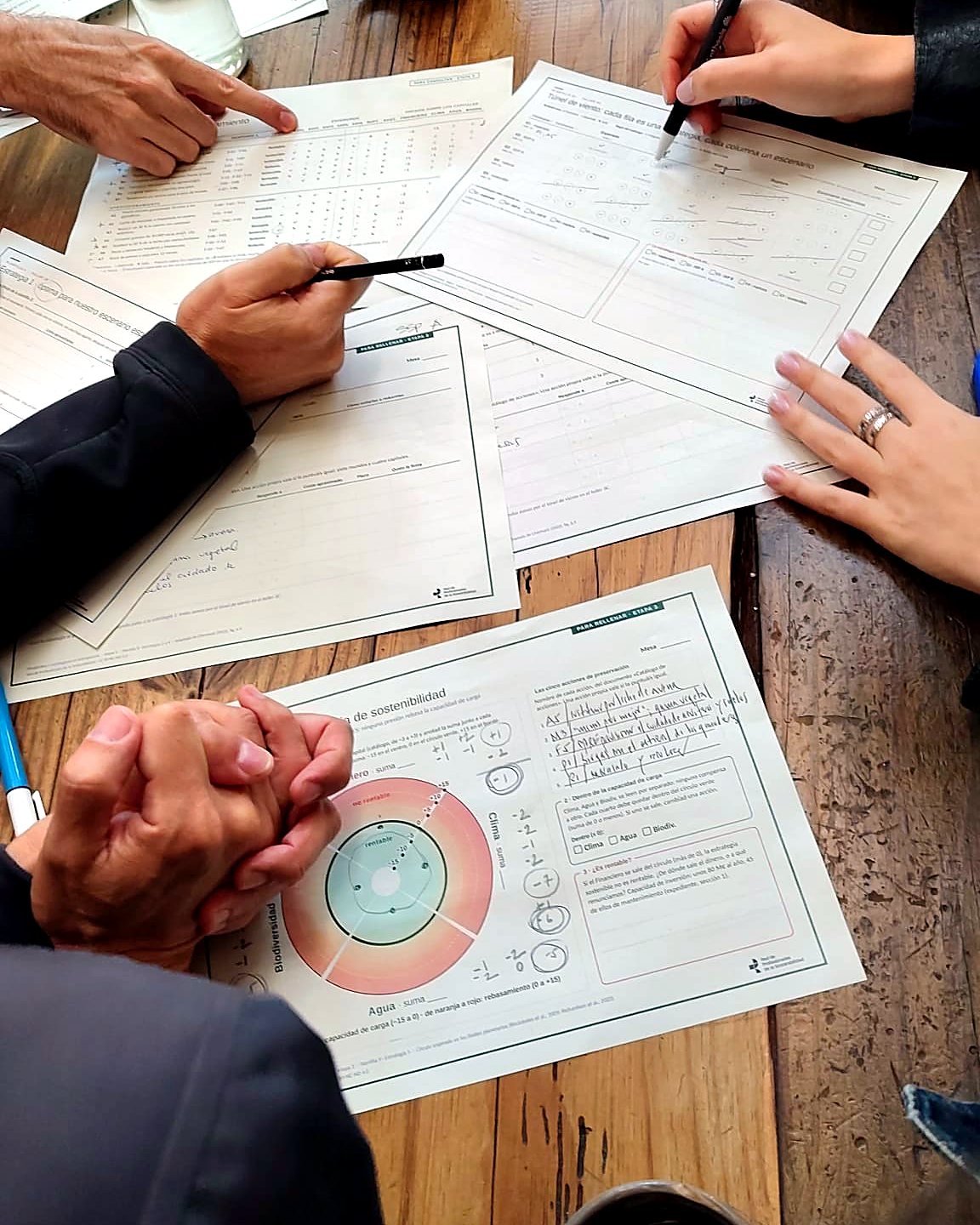
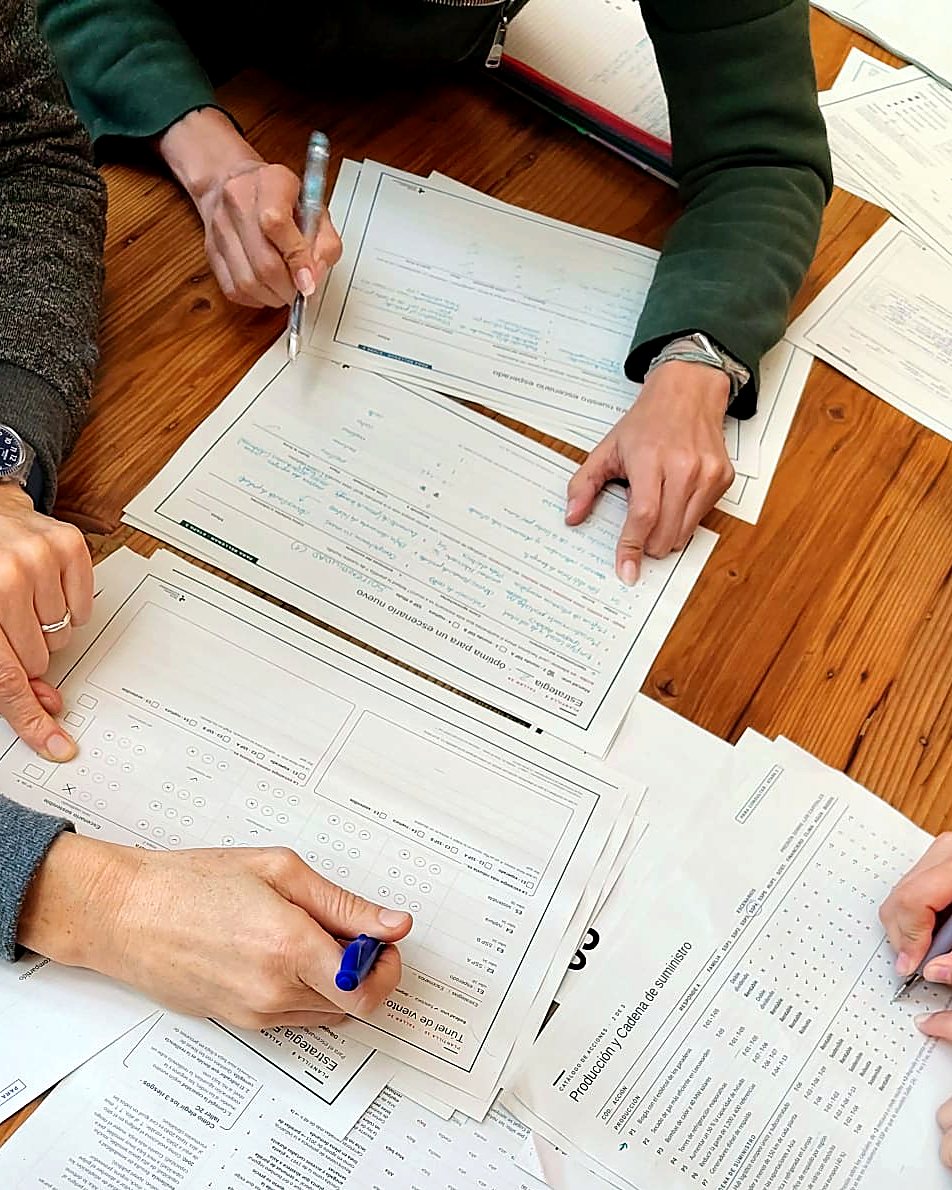
Paper, pencil and debate. Teams read the case, score each action in each scenario, cross out, argue and start again. Theory is there to decide with, not just to listen to.


Each workshop has its template: printed, filled in as a group and pinned to the wall. Click one to see it full size.
Five strategies go through five scenarios. Each one is optimal for its own: what matters is what happens off the diagonal.
A strategy that withstands the risks but fails in the sustainable scenario manages risk well and degrades the system it depends on.
Scenarios have no probability. You don’t pick the most likely one: you prepare a strategy that holds in several.
What matters is not how much something changes, but when it stops working, and what it drags down with it across the value chain.
The best strategy for one future is fragile in the others. Under deep uncertainty, the one that survives in all of them wins.
Preserving natural and human capital has a cost. You learn to make the trade-offs with your eyes open.
Executive committees and boards that set strategy and allocate capital.
Teams preparing the transition plan, the double materiality assessment and the climate risk analysis.
Those who build scenarios, risk maps and investment plans.
Professionals who support organisations and want a reusable method.
All the workshop materials are released under a CC BY-NC-ND 4.0 licence, so you can reuse the method with your teams.
The methodology and the tools, ready to print and to run the workshop yourselves.
Facilitator’s script: the workshop, step by step.
Overall presentation: the theory inputs and the briefs, with speaker notes.
Workshop briefs and the 11 templates, to print.
Case file — La Vaca Utopista: business, plants, markets.
SSP guide: the IPCC’s five worlds, read from an organisation’s perspective.
Risk cards: transition and physical risks, process by process.
Action catalogue: 42 actions with cost, timeline and owner.
The yoghurt of 2040.
Theory and methodology guide: the foundations and the method, in detail.
A short overview of the journey, from the expected future to the wind tunnel.
Author of the workshop and its materials.
Author of the design fiction phase.
Write to us to run the workshop in your organisation: over one, two or three days, with a fictional or tailored case, in English, French or Spanish.
Run a workshop